Website · Enterprise software
WordPress rebuild for vendor risk management software
A corporate WordPress site for a vendor risk management platform was rebuilt from Elementor to Oxygen Builder while preserving its content and commercial journeys.
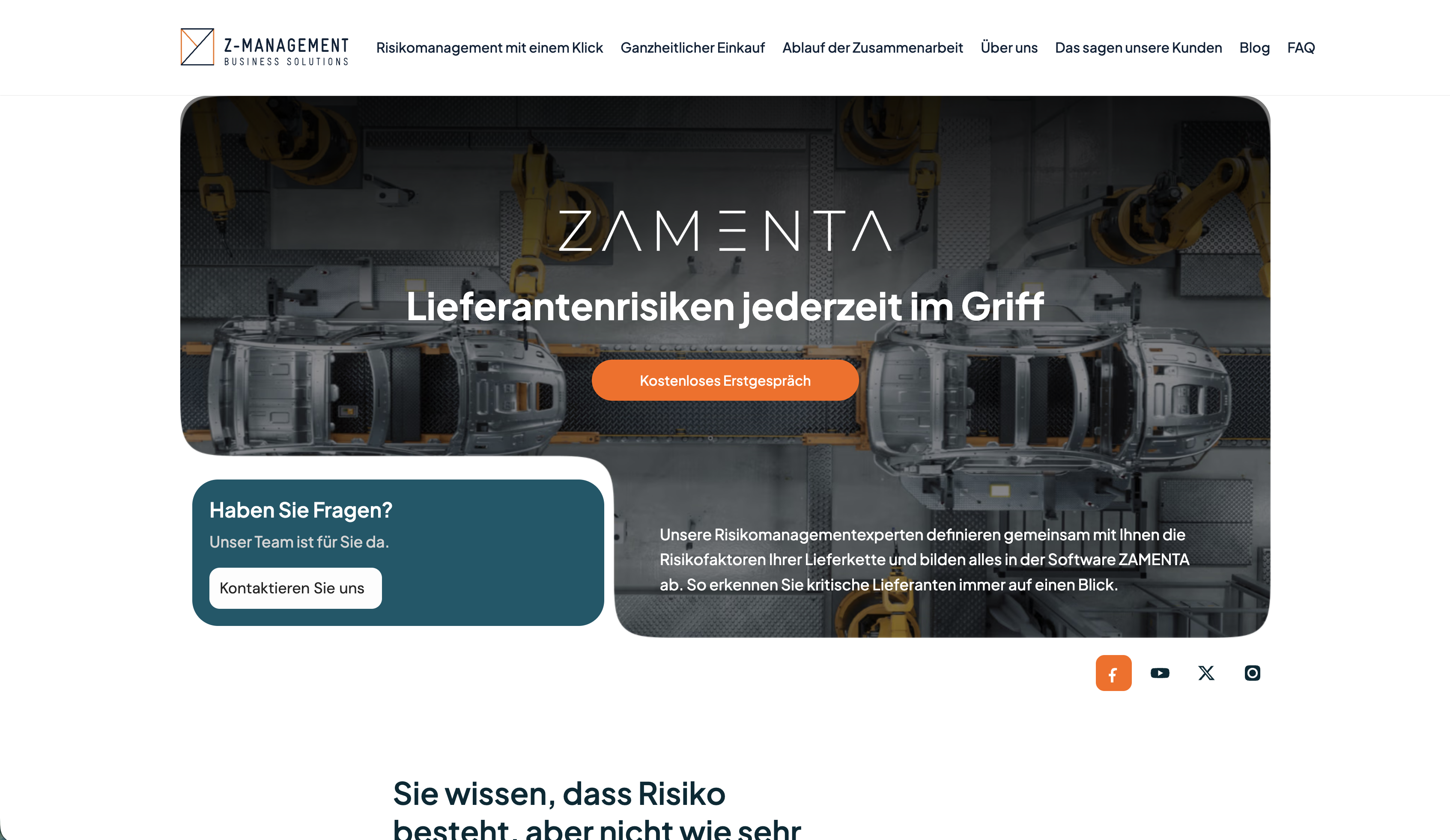
Challenge
A B2B software company already had a WordPress site built with Elementor. The website presented a platform for identifying and managing vendor-related risks, but the frontend needed to be rebuilt on a different foundation.
The change required more than installing another builder. Every page and component had to be reconstructed, the technical dependency on Elementor had to be removed, and the installation could not be left running two visual systems in parallel.
The site also had to explain a complex enterprise product to procurement, operations, and leadership audiences. Its pages combined product positioning, methodology, benefits, testimonials, frequently asked questions, editorial content, and calls to action.
One of the priority commercial journeys directed visitors to an external consultation-booking platform. Those conversion points had to remain available during the rebuild, and the URLs used by the different buttons needed to be reviewed.
Solution
My responsibility was to execute the technical reconstruction inside WordPress using Oxygen Builder. I rebuilt the pages, sections, and components to replace the layouts previously created with Elementor.
The work covered the navigation, hero, explanatory content blocks, process presentation, benefit sections, testimonials, frequently asked questions, and calls to action.
I also adapted the implementation across screen sizes, reviewing hierarchy, spacing, alignment, and component behaviour to maintain a consistent experience on desktop, tablet, and mobile devices.
Consultation journeys were connected through Calendly. As part of the technical review, I checked and updated the URLs used by the call-to-action buttons so each one directed visitors to the appropriate calendar.
SEO configuration remained inside WordPress through Rank Math. My contribution focused on the site implementation, frontend behaviour, and continuity of its public integrations.
I do not attribute the development of the software platform, the definition of its methodology, or its commercial claims to my work. Those areas belonged to the team responsible for the product.
Once the rebuild was complete, Elementor and Elementor Pro were removed from the installation. This avoided retaining the assets, configuration, and dependencies of two different page builders.
Outcome
The main pages were rebuilt in Oxygen Builder, and Elementor and Elementor Pro were removed completely from the WordPress installation.
Removing the previous builder left a single layout system for maintaining the site. This reduced the complexity of working across two visual systems and prevented new sections from continuing to depend on inherited Elementor components.
The rebuilt version retained the product presentation, methodology, benefits, testimonials, frequently asked questions, and access to editorial content. Calls to action remained connected to Calendly, preserving the direct journey from product information to consultation booking.
The resulting structure is ready for component updates and new pages built in Oxygen. No comparable before-and-after speed, Core Web Vitals, or conversion measurements are available, so the case does not claim undocumented numerical improvements.