Web application · Marketing technology
AI-powered SEO content platform for agencies
A subscription web app that uses coordinated AI agents to help agencies plan, generate, review, and publish SEO content for multiple client websites.
Challenge
Agencies producing SEO content for multiple clients repeat the same time-consuming process across every account: research topics, identify keywords, define a content plan, draft articles, create internal links, review the output, and publish it on the correct website.
Generating text is only one part of that workflow. A useful product also needs to coordinate decisions between stages, preserve context, introduce approval points, and prepare content for the technical structure of each client site.
The product was conceived to help agencies scale this work without simply replacing editorial judgement with a single prompt. Its efficiency target is to reduce the time required to produce blog content by up to 90%, while keeping people in control of the plan and publication process.
Supporting multiple client websites adds another layer of complexity. Projects may use WordPress or code-managed repositories, follow different content and image paths, and require their own frontmatter, templates, and publishing rules.
Solution
I co-founded the product with a software engineer who also works at PayPal. We collaborate on product strategy, architecture, and implementation, and I contribute directly across both the frontend and backend. This is an independent venture and is not affiliated with PayPal.
The web interface is built with Next.js and React. It gives agency teams a structured path from the initial topic to keyword planning, content generation, review, and publication instead of exposing the underlying AI workflow as a collection of disconnected prompts.
The backend is developed in Python. LangChain and LangGraph are used to coordinate specialised AI agents, maintain state between steps, and organise a workflow in which different tasks can be executed, reviewed, and continued in a controlled sequence.
Those agents support activities such as topic and keyword planning, article drafting, content-pack generation, and internal-link preparation. Human approval remains part of the process so an agency can validate the plan before content moves towards publication.
The product architecture also accounts for the differences between client sites. Project configuration can describe where posts and images belong and which rules the generated files must follow. The evolving publishing layer is intended to support both WordPress websites and sites whose content is managed through code repositories.
My work spans product decisions, interaction flows, React implementation, backend services, agent orchestration, and the integrations required to turn generated content into a publishable asset.
Outcome
The application is available as a public beta and is being tested with a small group of agencies. Their feedback is being used to refine the content workflow, approval experience, integrations, and the way multiple client projects are managed.
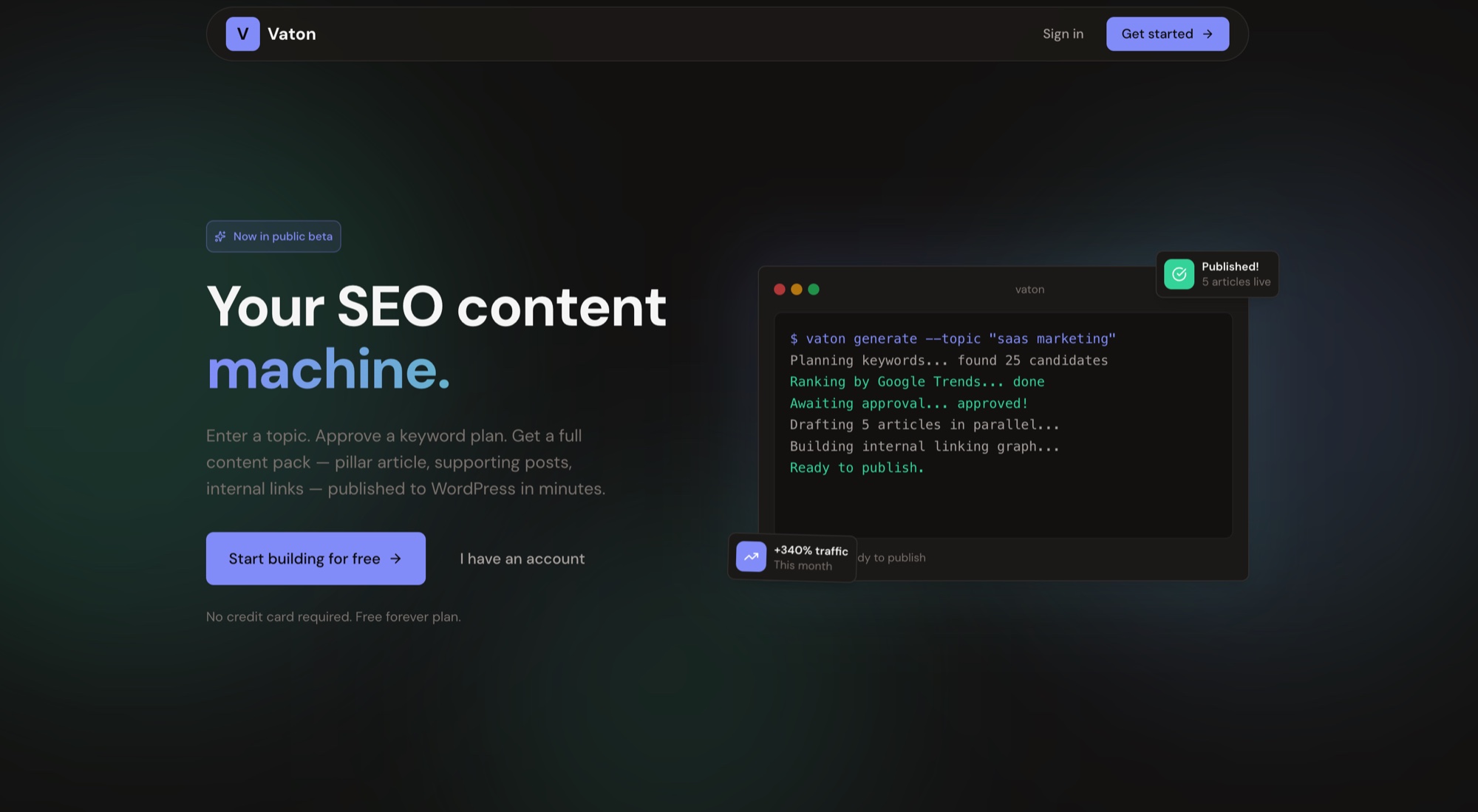
The beta brings the core process into one web application: start from a topic, prepare a keyword plan, generate a coordinated content pack, build internal-link relationships, review the result, and move approved content towards publication.
The product continues to expand as real agency workflows reveal where automation is useful and where editorial control must remain explicit. This makes the current beta both a usable application and an active product-development environment.
The target of reducing blog-production time by up to 90% is the product’s efficiency proposition and is still being validated with beta users. No independently verified time-savings, ranking, traffic, or conversion figures are presented as confirmed results at this stage.