Build in Modules: A Practical Path from MVP to Advanced Features
A practical SOP for structuring a modular product from a focused MVP to advanced features, using evidence from real use to guide each next step.
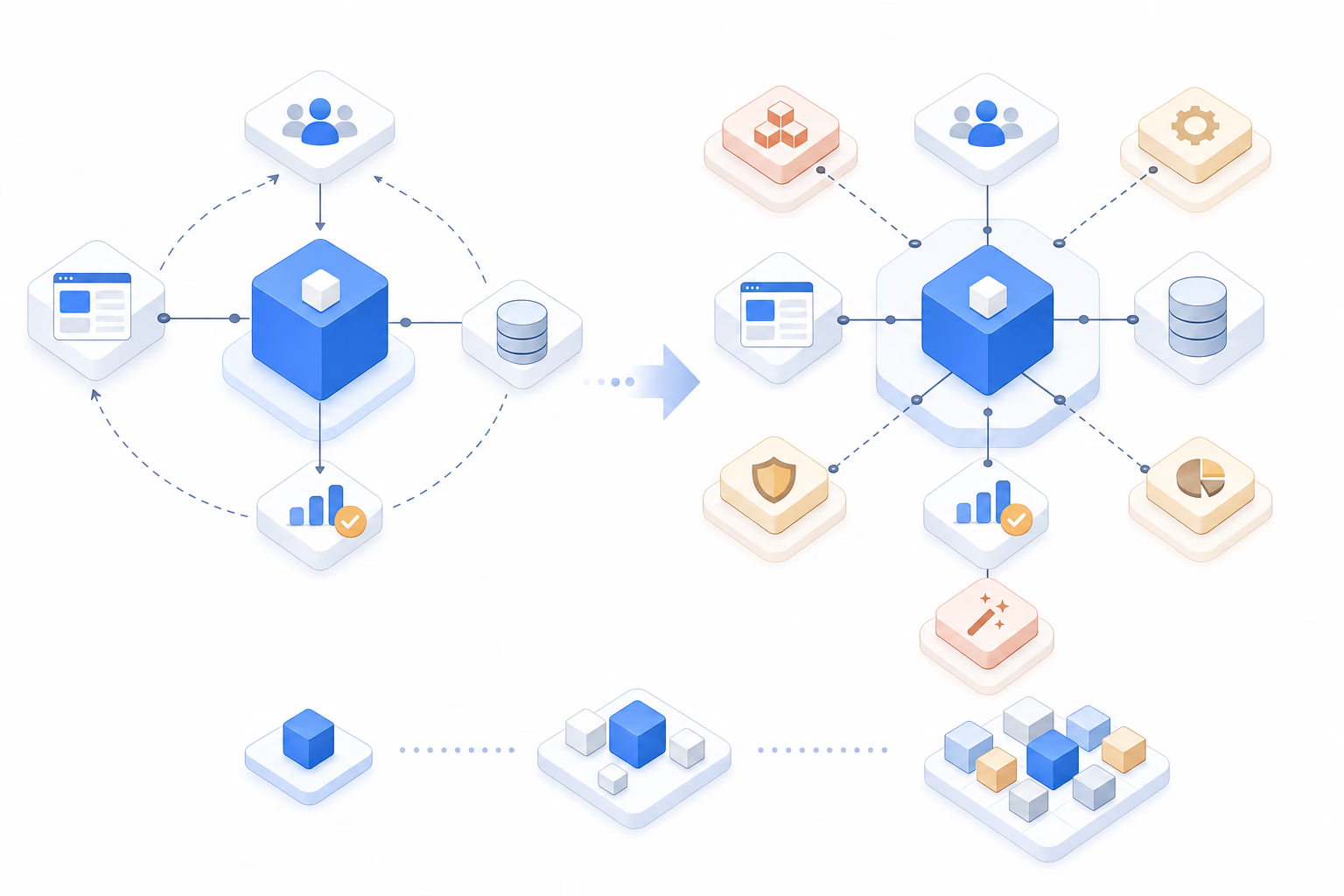
Start with a testable assumption
An MVP is not simply a smaller version of the final product. It is the smallest usable path that helps you examine one important assumption: whether a specific audience has a problem and sees enough value in your proposed solution to use it.
Write that assumption before splitting the project into modules. For example: “Independent consultants will use a simple workspace to organize client requests.” This gives the team a criterion for inclusion: if a component does not help someone complete the test or help you learn from it, it can wait.
Map the first user journey
Describe the shortest journey a real person must complete to experience the core value. A basic sequence might be:
- Arrive at the product.
- Create or access an account if that step is essential.
- Add the minimum required information.
- Receive the intended result.
- Share feedback or return to the product.
Turn this journey into a thin vertical slice: an end-to-end flow, however simple, that crosses interface, application logic, and data only where necessary. Avoid beginning with a broad list of screens or with infrastructure intended for future scale.
Split the product by responsibility
Modularization works best when each area has a clear responsibility and limited dependencies. The precise folder structure and technology can vary, but the boundaries should be understandable to the team.
A useful starting map can include:
- Core domain: the entities and rules that represent the main problem.
- User flows: use cases such as onboarding, creating a request, or viewing a result.
- Interface: screens and reusable components that present those flows.
- Infrastructure: data access, authentication, messaging, integrations, and deployment configuration.
- Measurement: events and feedback mechanisms tied to the assumption being tested.
Do not create every module in full on day one. Define the boundaries, then build only the parts that the first journey needs. A module can begin as a small implementation behind an interface that leaves room for change.
Decide what belongs in the MVP
For each proposed feature, ask three questions:
- Does it allow the user to reach the core outcome?
- Does it reduce a risk that would invalidate the test?
- Does it produce information needed for the next product decision?
If the answer is no to all three, place it in a later stage rather than adding it to the MVP.
Authentication, payments, roles, notifications, and integrations are common examples. They may be essential in some products, but they should not be treated as automatic requirements. Consider the simplest safe alternative that preserves the learning goal: a manual process, a single user role, an invitation-only pilot, or an existing third-party service.
Use stages instead of a single roadmap backlog
A staged plan makes the path from validation to advanced functionality easier to discuss.
Stage 1: Validate the core action
Build the narrowest complete flow. Define what you want to observe, such as completed tasks, repeat use, qualitative feedback, or requests to continue. Choose measures that fit the hypothesis instead of treating activity alone as proof of demand.
Stage 2: Remove the largest friction
After observing real use, identify the main obstacle in the journey. It may be confusion, a missing input, slow manual work, or lack of trust. Prioritize the improvement that most directly addresses that obstacle.
Stage 3: Make repeated use workable
When people return, introduce capabilities that support recurring work: saved data, clearer history, basic permissions, or more reliable operations. Add them because the observed workflow calls for them, not because they were always planned.
Stage 4: Extend with advanced capabilities
Only after the core workflow has evidence behind it should you consider deeper automation, integrations, analytics, team roles, configuration options, or performance work. Keep these additions modular so they do not rewrite the proven path.
Keep module contracts small
Modules become hard to change when they depend on each other’s internal details. Prefer explicit, narrow contracts: a function, API endpoint, event, or data shape with a stated purpose.
For every connection, document:
- What input is expected.
- What output or side effect is produced.
- Which errors or unavailable states matter.
- Who owns changes to the contract.
This does not require extensive documentation for an MVP. A short decision note and a few examples can be enough. The goal is to prevent a quick experiment from becoming an opaque set of hidden dependencies.
Design for replacement, not premature scale
Early choices will often change after feedback. Instead of attempting to predict every future need, isolate the choices most likely to change. For example, keep the product’s core rules separate from a specific payment provider, AI service, database query, or notification channel.
A simple adapter layer can be useful when an external dependency is central or uncertain. But adding abstraction everywhere can slow the MVP down. Introduce it where a likely replacement would otherwise affect several parts of the product.
Add feedback and measurement from the first release
Without a way to observe use, the team may confuse development progress with validation. Add only the signals that answer the current question. These could include completion of the main action, a voluntary feedback prompt, notes from pilot users, or support requests.
Define in advance how you will review the evidence and what decisions it can inform. Numbers need context: a low completion rate may indicate lack of interest, but it may also reveal an unclear interface or an issue in recruitment. Combine behavioral signals with direct conversations when possible.
Review the architecture after each learning cycle
At the end of a cycle, review the product rather than blindly expanding the backlog:
- Which assumption gained support, and which remains uncertain?
- Which part of the journey caused the most friction?
- Which module changed most often?
- Did any temporary shortcut become a risk for the next stage?
- What is the smallest next change that can reduce uncertainty?
Refactor when a repeated change reveals a weak boundary, a confusing responsibility, or an unstable contract. Do not refactor merely to make an early prototype look like a mature platform.
A practical operating checklist
Before moving from one stage to the next, confirm that you can answer:
- What user problem are we testing now?
- What is the smallest complete journey for that test?
- Which modules are required for that journey?
- Which requests are deliberately deferred?
- What evidence will guide the next decision?
- Which dependency is most likely to change, and is it sufficiently isolated?
A modular MVP is not a promise that no code will be replaced. It is a way to make replacement, learning, and incremental expansion less disruptive. Build a clear path to test the idea first; let observed needs determine what deserves to become an advanced feature.